Full periodic table
This table groups atomic number, symbol, name, and displayed mass in each tile. Use the full-size view to inspect the layout; the selected data table below provides the accessible text resource.
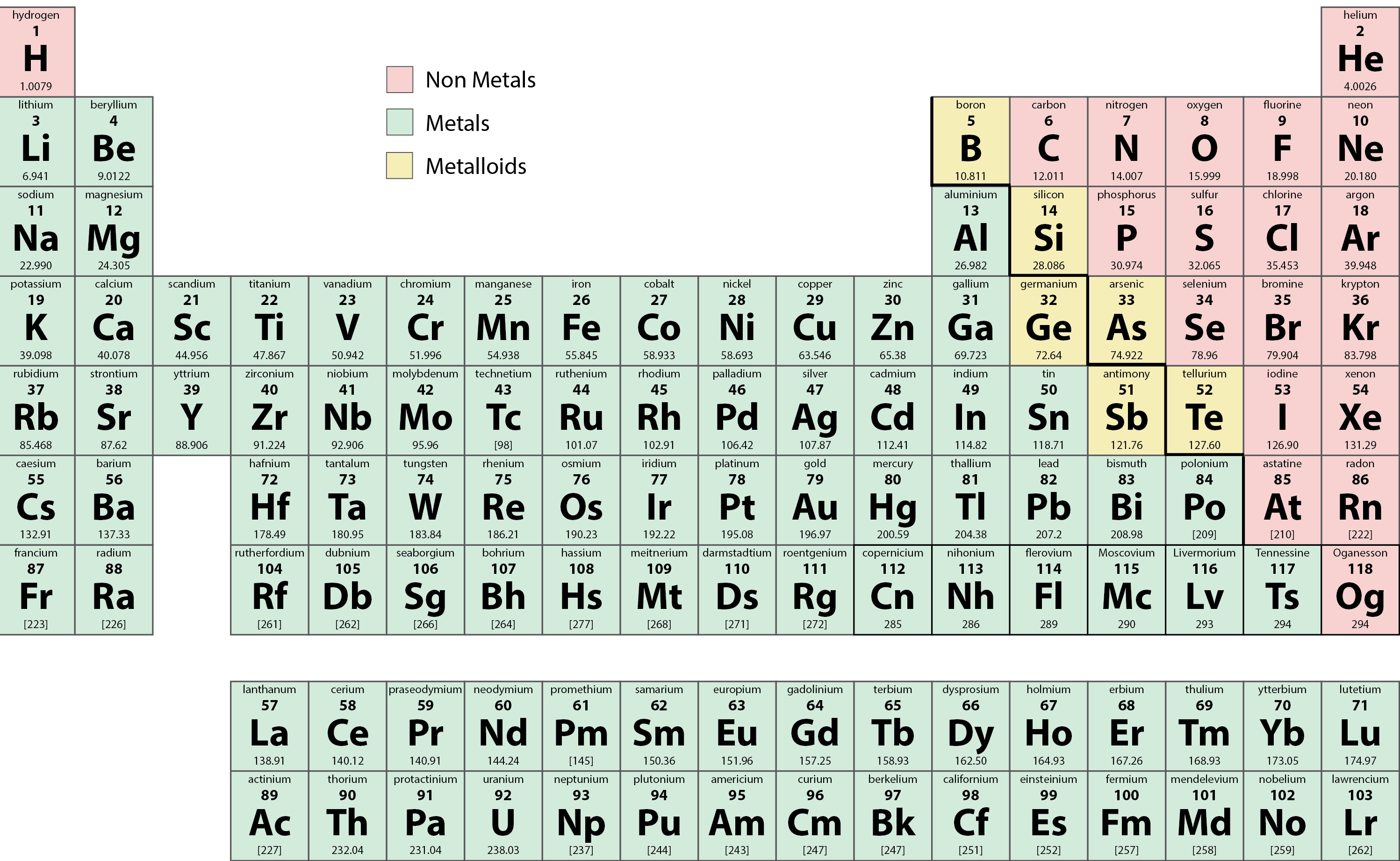
Common elements and molar masses
This is selected data, not a second full periodic table. Values are rounded to useful introductory precision in grams per mole (g mol−1). For a calculation, use one consistent data set and keep the requested significant figures.
| Atomic number | Symbol | Element | Molar mass (g mol−1) | Frequent ion or species |
|---|---|---|---|---|
| 1 | H | Hydrogen | 1.008 | H+, H2 |
| 6 | C | Carbon | 12.011 | CO2, CO32− |
| 7 | N | Nitrogen | 14.007 | N2, NH4+ |
| 8 | O | Oxygen | 15.999 | O2−, O2 |
| 11 | Na | Sodium | 22.990 | Na+ |
| 12 | Mg | Magnesium | 24.305 | Mg2+ |
| 17 | Cl | Chlorine | 35.45 | Cl−, Cl2 |
| 19 | K | Potassium | 39.098 | K+ |
| 20 | Ca | Calcium | 40.078 | Ca2+ |
| 26 | Fe | Iron | 55.845 | Fe2+, Fe3+ |
| 29 | Cu | Copper | 63.546 | Cu+, Cu2+ |
| 35 | Br | Bromine | 79.904 | Br−, Br2 |
| 47 | Ag | Silver | 107.868 | Ag+ |
| 53 | I | Iodine | 126.904 | I−, I2 |
Constants, units, and conversions
| Quantity | Symbol and value | Unit or condition |
|---|---|---|
| Avogadro constant | NA = 6.022 140 76 × 1023 | mol−1, exact SI value |
| Molar gas constant | R = 8.314 462 618 153 24 | J mol−1 K−1, exact SI value from exact kB × NA |
| Molar gas constant | R ≈ 0.082 057 366 | L atm mol−1 K−1, converted and rounded for calculation |
| Elementary charge | e = 1.602 176 634 × 10−19 | C, exact SI value |
| Standard atmosphere | 1 atm = 101 325 Pa = 101.325 kPa | exact conversion by definition |
| Volume | 1 L = 1000 mL; 1 mL = 1 cm3 | the latter is exact |
| Temperature | T (K) = t (°C) + 273.15 | use kelvin in gas-law ratios |
| Energy | 1 kJ = 1000 J | prefix conversion |
NIST CODATA lists exact SI values for NA, R, e, the standard atmosphere, and ideal-gas molar volumes at stated pressures. The SI value of R is exact; the L atm form shown here is rounded. “Standard” pressure and “room temperature” are not interchangeable conditions.
Formula toolkit
In this page, M means molar mass and c means amount concentration. Some textbooks use M for molarity; read each symbol definition before substituting.
| Relationship | Symbols and units | Use and condition |
|---|---|---|
| ρ = m ÷ V | ρ density; m mass; V volume | Use matching units, such as g mL−1. |
| n = m ÷ M | n mol; m mass (g); M molar mass (g mol−1) | Mass and molar mass must describe the same substance. |
| N = nNA | N entities; n mol; NA mol−1 | Specify atoms, molecules, formula units, or ions. |
| c = n ÷ V | c molarity (mol L−1); V final solution volume (L) | Use final solution volume. |
| c1V1 = c2V2 | c concentration; V volume | Dilution of the same solute; use matching volume units. |
| n2 = n1(ν2 ÷ ν1) | n amount in mol; ν balanced-equation coefficient | Use coefficients as mole ratios only after balancing the equation. |
| pV = nRT | p pressure; V volume; n mol; R matching gas constant; T (K) | Ideal-gas model; use L/atm R with L and atm, or SI R with Pa and m3. |
| q = mcΔT | q heat (J); m mass (g); c specific heat (J g−1 °C−1); ΔT change | For one phase with approximately constant c over the temperature range and no phase change. Here c is specific heat capacity, not concentration. |
| percent yield = actual ÷ theoretical × 100% | Both yields use the same product and units. | Find theoretical yield from the limiting reactant and balanced equation. |
| pH = −log10(aH+); pOH = −log10(aOH−) | a is activity, dimensionless | For dilute introductory aqueous work, pH ≈ −log10([H3O+] ÷ 1 mol L−1) and similarly for pOH. At 25 °C, pH + pOH ≈ 14.00; temperature and activity change the relationship. |
Two quick setups
Particles: 0.250 mol CO2 × 6.022 × 1023 molecules mol−1 = 1.51 × 10²³ CO2 molecules. Each molecule has three atoms, so it contains 4.52 × 10²³ atoms.
Dilution: To prepare 100.0 mL (0.1000 L) of 0.200 mol L−1 solution from 1.00 mol L−1 stock, V1 = (0.200)(0.1000) ÷ 1.00 = 0.0200 L = 20.0 mL. Add solvent until the final volume is 100.0 mL.
Common polyatomic ions
Keep each ion’s charge together when writing an ionic formula. Parentheses show that more than one copy is present, as in Ca(NO3)2.
| Name | Formula | Name | Formula |
|---|---|---|---|
| Ammonium | NH4+ | Hydroxide | OH− |
| Acetate | C2H3O2− | Nitrate | NO3− |
| Nitrite | NO2− | Carbonate | CO32− |
| Hydrogen carbonate | HCO3− | Sulfate | SO42− |
| Sulfite | SO32− | Phosphate | PO43− |
| Permanganate | MnO4− | Chromate | CrO42− |
| Dichromate | Cr2O72− | Cyanide | CN− |
“Per-” and “-ite” names are patterns, not a license to guess every ion. Confirm an unfamiliar ion in a trusted reference and check total charge on the final formula.
Glossary
- Amount of substance, n
- A measure of specified entities; one mole contains exactly NA entities.
- Activity
- A dimensionless effective amount used in equilibrium and pH definitions; dilute solutions often approximate it with concentration.
- Concentration
- An amount relative to a defined volume or amount of solvent. This page uses c for molarity.
- Limiting reactant
- The reactant consumed first by the balanced equation, setting theoretical product amount.
- Molar mass, M
- Mass per amount of substance, commonly in g mol−1.
- pH
- A logarithmic quantity defined from hydrogen-ion activity, not simply a universal synonym for concentration.
- Specific heat capacity, c
- Heat needed per unit mass for a temperature change. It is different from concentration even though both are sometimes written with c.
- Stoichiometric coefficient
- A number in a balanced equation that supplies mole ratios between substances.
Sources and limits
These sources support the constants, definitions, and periodic-table context used here; the explanations and tables on this page are original summaries.
- NIST CODATA 2022 fundamental constants (PDF), including exact SI values for NA, R, the standard atmosphere, and ideal-gas molar volumes at stated pressures.
- IUPAC Periodic Table of the Elements, for current names, symbols, and atomic-weight context.
- IUPAC Gold Book: pH, for the activity-based definition and measurement caveat.
- IUPAC Gold Book: amount of substance, for specified entities and the mole.
- OpenStax Chemistry 2e: Ionic and Molecular Compounds, for common polyatomic ions and charge-balanced formulas.
- OpenStax Chemistry 2e: Reaction Stoichiometry, for coefficients as mole ratios.
- OpenStax Chemistry 2e: Energy Basics, for specific heat and the conditions for q = mcΔT.
- OpenStax Chemistry 2e: Chapter 14 Summary, for Kw and the 25 °C pH/pOH relationship.
- OpenStax Chemistry 2e: Fundamental Physical Constants, for accessible constants and unit forms.
Rounded classroom values suit many introductory calculations. Use a current laboratory reference when uncertainty, isotope composition, gas conditions, solution activity, or high precision affects the answer.